

Child Counseling and Play Therapy in Ridgeland, MS
Children say it in play before they can say it in words.
You may be here because asking what's wrong stopped working.
The meltdowns are bigger than the thing that caused them. Mornings have become a fight about school. She was fine and now she is not sleeping. He hits his brother and then sobs about it. Somebody at school used the word behavior in a meeting and you left feeling judged.
You have asked what is wrong. You have asked gently, and then less gently. You get I don't know, or nothing, or a shrug, and the distance grows a little each time you ask.
That is not defiance and it is not bad parenting. A seven-year-old often does not have the words, because the part of the brain that would supply them is still under construction. Asking harder does not build it faster.
One of our child therapists is a Registered Play Therapist (RPT), credentialed by the Association for Play Therapy.
Who this helps
Who this is for
Children roughly three and up, depending on the therapist and the concern. Common reasons families come in:
Anxiety, worry, and separation difficulty
Anger, aggression, and behavior that has become hard to manage
Grief and loss
Divorce, blended family transitions, and family change
Trauma and adverse experiences
School refusal, academic stress, bullying, and social difficulty
Sleep and eating changes tied to stress
Emotional regulation and big feelings
Foster care, adoption, and placement change
Age minimums vary by therapist. For ages 10 to 12, our intake coordinator will help you decide whether play therapy or talk therapy is the better fit.
Our approach
How play therapy works
- 1
Child-centered play therapy
Follows the child's lead, giving them a place where they are in charge of something, which for a child whose life recently changed without their consent is not a small thing.
- 2
Directive play therapy
Introduces specific activities to build a particular skill or approach a particular subject.
- 3
Trauma-Focused Cognitive Behavioral Therapy
A structured approach for children and adolescents that typically includes caregivers.
- 4
Child-Parent Psychotherapy
Treats the relationship between child and caregiver as the thing being strengthened.
- 5
Caregiver guidance.
Most child work includes you. Not as the problem to be corrected, but as the person with the most influence in the room your child actually lives in.
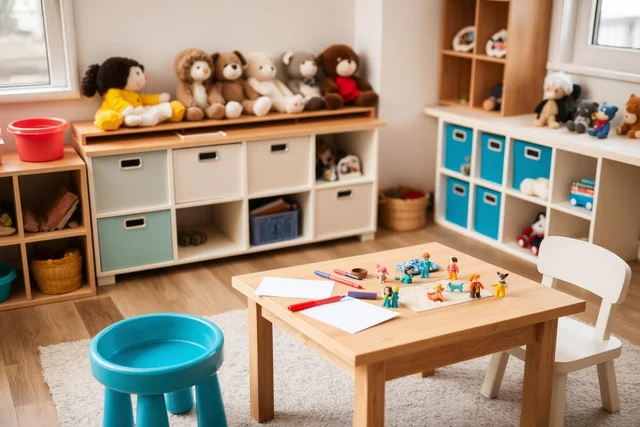
Play is how children process experience, practice skills, and communicate what they cannot yet say. In a playroom set up with materials chosen to invite emotional expression, a trained therapist watches what a child builds, repeats, avoids, and resolves, and works inside that.
Our team includes a Registered Play Therapist, a special credential requiring supervised play therapy hours beyond a counseling license.
Availability varies by therapist. It depends on which clinician you are matched with and how flexible your availability is. If you need to be seen sooner, say so when you call and we will tell you honestly what is possible.
Why specialized child care matters
Children are not small adults. An approach that works with a thirty-five-year-old, sitting across from someone and describing your feelings for fifty minutes, asks a child to do something they are not developmentally built to do. When it fails, the child is often described as resistant.
Specialized training also matters for what happens around the therapy: knowing when to involve a caregiver and when the child needs a space of their own, how to talk with a school, when a behavior signals something requiring a different level of care.
Meet your specialist
Therapists who do this work


What to expect
What to expect

- 1
The first call.
Tell our intake coordinator your child's age, what you are seeing, when it started, and anything that has changed at home or school. We match on age range and concern, since not every therapist works with every age.
- 2
The first session.
Usually caregivers first, sometimes without the child, so you can speak freely. Your therapist will gather history and explain how the work will run.
- 3
Your child's sessions.
Your child will play. That is the therapy, not the warm-up. Your therapist will give you regular feedback about themes and progress while protecting enough privacy for your child to trust the room.
- 4
Your part.
Expect to be involved: caregiver sessions, strategies to try at home, and sometimes work on the relationship itself.
- 5
Length.
Depends on the concern. Focused work around a specific change may be relatively short. Trauma, grief, and attachment concerns take longer.
Cost and availability
Cost, insurance, and getting in
We work with Blue Cross Blue Shield of Mississippi, Aetna, UnitedHealthcare or UMR, and Fox Everett. Participation varies by clinician and by plan, so call us and we will confirm your benefits before your first session.
Availability varies by therapist. It depends on which clinician you are matched with and how flexible your availability is. If you need to be seen sooner, say so when you call and we will tell you honestly what is possible.
Where we meet
In Ridgeland

Our office is at 197 Charmant Place, Suite 2 in Ridgeland, convenient to Madison, Jackson, Flowood, Brandon, and Clinton.
Play therapy is generally done in person, since the playroom is part of the treatment. Some caregiver sessions and some work with older children can happen by telehealth for clients physically located in Mississippi. Your therapist will tell you what fits.
Common questions
A developmentally appropriate form of therapy in which a trained therapist uses play intentionally to help a child process experience, build coping skills, and work through emotional or behavioral concerns. It looks like playing because for a child that is what communication looks like.
You do not have to know what your child needs.
Tell us what you are seeing and we will help you find the right therapist for their age and situation.
Availability varies by therapist. It depends on which clinician you are matched with and how flexible your availability is. If you need to be seen sooner, say so when you call and we will tell you honestly what is possible.
Stillwaters is an outpatient counseling practice and is not an emergency service. If you are in immediate danger or unable to stay safe, call 911 or call or text 988.